
New York Times
Thursday, July 14, 1927 - page 1
$1,250,000 DAMAGE IN PALESTINE QUAKE
Thousands of Homeless Sleep in the Open in Fear of a Recurrence of Tremors
400 BODIES FOUND IN RUINS
Few Buildings Escaped Harm, and Others May Collapse -- Nathan Straus Sends 5,000 Pounds.
Copyright 1927 by The New York Times Company
Special Cable to the New York Times
JERUSALEM, July 13
Thousands were left homeless by Monday's earthquake, in which in Palestine alone hundreds were killed and 1,000 were injured.
Though expert examination is still to be made, it is believed that no irreparable damage was caused to historic buildings, but hundreds of private houses will require extensive repair or rebuilding. In fact, very few buildings of any kind entirely escaped.
The "Dome of the Rock" it is now stated was badly shaken and the many repairs of recent years were rendered useless. Serious injury to the Government house on the Mount of Olives rendered it unfit for habitation, and the tower is in danger of collapse. A Russian maid servant was killed in the building by falling stones.
The slender tower of the Russian building still stands, though there are fears for its safety. Serious cracks appeared in one minaret of the Haram-es-Sherif and the Chapel of the Ascension on the Mount of Olives has been badly damaged, the upper part of its minaret having broken off.
Banked portions of the Jericho Road have shifted slightly in parts and it is somewhat unsafe. The Church Missionary Society school, southwest of the Old Wall of Jerusalem, had much damage done to its walls.
Ancient Churches Marred.
In the Basilica in Bethlehem there is a crack opposite the Armenian Door and many in the walls of the Armenian Convent. The Armenian Church of St. James in Jerusalem apparently was unhurt, but most of the arches were cracked in the monastery.
The top of the minaret at David's Tower was broken off and some stones were displaced in the other tower.
The Hebrew University is estimated to have suffered many thousands of dollars damage and the well-built new Jewish quarter north of Jerusalem was badly shaken. So violent was the shock in certain areas that many persons were thrown from their beds.
At the Russian compound the shock was so sever that three of the columns supporting the cupola of the Russian church fell, leaving the cupola precariously supported by the four remaining columns. In the Beth Israel quarter the Bagdhdadese Synagogue collapsed.
The Winter Palace Hotel in Jericho fell to the ground. Three Indian tourists were killed and many other guests were injured.
The loss of life was serious in the villages around Jerusalem, such as Ain Karim, Lifta, Silawan, Yalo, Ramleh, Abu Dis, Beth Iksa and Bir Zeit. In Semakh and Acca the mosques were badly damaged. In Amman, where ten were killed, the British representative's house and the Prime Minister's house were destroyed. At Es Salt eighty-five were killed and 180 were injured.
Many persons slept in the open last night, some for fear of further shocks, and other because their homes had been destroyed by the earthquake.
The Samaritan community at Nablus suffered greatly. Their synagogue shows dangerous cracks. All of the houses collapsed or are in danger of collapsing. The community is now living in tents in the cemetery of the hillside.
400 Bodies of Victims Recovered
JERUSALEM, July 13 (Jewish Telegraphic Agency)
Four hundred bodies have been recovered from the debris of the earthquake Monday afternoon in Palestine cities and villages.
The loss suffered by the public and private buildings in the earthquake was set at $1,250,000 in a tentative estimate made today.
According to the list compiled by Authorities, the number of injured was placed at 450. The list shows that eight were killed in Amman, the capital of Transjordania, and eighty-five in Es Salt. No casualties were reported among the Jewish population in the country.
Thousands of families all over the country spent last night in the open air, fearing a repetition of the earthquake. Not a house in Jerusalem or Hebron is without some damage.
Two synagogues, one in Jerusalem, the other in Tiberias, were destroyed. In several Palestinian towns the Moslem mosques and the Government office buildings were damaged. The house of the British representative in Amman, Transjordania, was totally destroyed. The Church of the Holy Sepulchre, as well as the Greek Choir Chapel and two large domes are damaged.
A message of sympathy was received by Colonel Symes, Acting High Commissioner, from Lord Plumer, the High Commissioner, who is now on vacation in England.
Hopeful for Temple Area
JERUSALEM, July 13 (AP)
A leading Moslem architect, who has inspected the temple area, estimates that the total damage by the earthquake there at less than 1000 Pounds.
He denies the report that the Dome of the Rock, or Kubbet Es-Sakhra has been damaged by the quake; he says that a slight crack visible in the mosaic work is probably due to earlier deterioration.
Quake Caused Avalanche of Melons
LONDON, July 13 (AP)
The Daily Mail's Haifa (Syria) correspondent says that 500 persons were killed in the earthquake in Palestine and Transjordania and that more than 700 houses in Jerusalem and the surrounding districts were damaged.
These included the Greek convent and the Patriarch's residence on the Mount of Olives. A minaret fell while a sheik was reciting prayers, killing him.
The damage to Jerusalem is estimated at about 100,000 Pounds.
Thousands of watermelons rolled from a warehouse at Haifa owing to the vibrations of the earthquake and while some persons ran for safety, others chased the melons and feasted.
Disaster Grieves the Pope.
ROME, July 13 (AP)
Pope Pius has been deeply grieved by the news of the earthquake disaster in the Holy Land and has sent instructions to the Patriarchs at Jerusalem concerning relief work.
The Pontiff has made many inquiries concerning the gravity of the disaster.
No Americans in Casualties.
Special to The New York Times.
WASHINGTON, July 13
Twenty-five were killed and thirty-eight injured in the Jerusalem district earthquake on Monday, according to first reports on the disaster received by the State Department from Oscar S. Heizer, the American Consul at Jerusalem. No Americans were killed or injured so far as known.
With reports from several districts missing, Heizer said casualties were summarized as follows: At Ramleh-19 killed, 28 wounded. At Nablus-15 killed, 250 wounded. At Ramallah District-3 killed. At Hebron-3 killed.
STRAUS CABLES 5,000 Pounds AID.
Zionist Women Send $40,675 for Palestine Quake Relief.
Nathan Straus cabled 5,000 pounds to Jerusalem yesterday for the relief of earthquake sufferers. The Hadassah, or Women's Zionist Organization of America, sent $40,675 for the same purpose.
Mr. Straus sen the following cablegram to Dr. E. M. Bluestone, Director of the Hadassah Hospital in Palestine:
Sending five thousands pounds by cable for feeding and caring for earthquake sufferers without distinctions race or creed. Please use funds through my soup kitchen and child welfare station and Hadassah for action relief not for building repairs. Confirm receipt. NATHAN STRAUS
The Hadassah Medical Organization has a staff of 550 persons. Dr. E. M. Bluestone, former Assistant Director of Mount Sinai Hospital, is Director of the organization. The Hadassah hospitals, clinics and infant welfare stations are conducted according to scientific American standards.
Thursday, April 7, 2011


Tuesday, April 5, 2011
Jerusalem Land Excursion from Ashdod Port May 5 2011
Meet at the entrance to Ashdod Port at 8 AM and drive directly to Mount of Olives above Jerusalem for a magnificent view of the Old City.
Walk down the Pilgrim's Path (1/4 mile)stopping at Dominus Flavit Chapel to the Garden of Gethsemane and the Franciscan Basilica of the Agony.
Enter the Old City at Zion Gate visiting the Armenian and Jewish Quarter including the Western or Wailing Wall - the sole remnant of the 2nd Temple destroyed by the Romans in 70 AD).
Walk into the Muslim Quarter and onto the Via Dolorosa (the Way of the Suffering) and observe the 14 Stations of the Cross to the Christian Quarter and the Church of the Holy Sepulchre the site of the last 4 Stations.
Stop for a quick bite to eat along the way at the famous Abu Shukri restaurant that features the best humus in and falafel in Jerusalem (@10 USD/person)
AFTER QUICK, LUNCH WE WILL ASCEND TO THE TEMPLE MOUNT TO VISIT THE HOLY SANCTUARY THAT INCLUDES THE SITE OF THE FIRST AND SECOND TEMPLES AND TODAY THE DOME OF THE ROCK AND AL AQSA MOSQUE.
WE WILL CONCLUDE OUR DAY WITH AN EXCITING VISIT TO THE ORIGINAL CITY OF DAVID ARCHEOLOGICAL SITE WITH AN ADVENTUROUS WALK THROUGH A CANAANITE TUNNEL AND RECENTLY EXCAVATED ROMAN PASSAGEWAY LEADING BACK TOWARD THE TEMPLE MOUNT
Walk down the Pilgrim's Path (1/4 mile)stopping at Dominus Flavit Chapel to the Garden of Gethsemane and the Franciscan Basilica of the Agony.
Enter the Old City at Zion Gate visiting the Armenian and Jewish Quarter including the Western or Wailing Wall - the sole remnant of the 2nd Temple destroyed by the Romans in 70 AD).
Walk into the Muslim Quarter and onto the Via Dolorosa (the Way of the Suffering) and observe the 14 Stations of the Cross to the Christian Quarter and the Church of the Holy Sepulchre the site of the last 4 Stations.
Stop for a quick bite to eat along the way at the famous Abu Shukri restaurant that features the best humus in and falafel in Jerusalem (@10 USD/person)
AFTER QUICK, LUNCH WE WILL ASCEND TO THE TEMPLE MOUNT TO VISIT THE HOLY SANCTUARY THAT INCLUDES THE SITE OF THE FIRST AND SECOND TEMPLES AND TODAY THE DOME OF THE ROCK AND AL AQSA MOSQUE.
WE WILL CONCLUDE OUR DAY WITH AN EXCITING VISIT TO THE ORIGINAL CITY OF DAVID ARCHEOLOGICAL SITE WITH AN ADVENTUROUS WALK THROUGH A CANAANITE TUNNEL AND RECENTLY EXCAVATED ROMAN PASSAGEWAY LEADING BACK TOWARD THE TEMPLE MOUNT
Walking Tour of Shivtei Yisrael Street in Jerusalem
JERUSALEM MUNICIPALITY TOUR SATURDAY APRIL 2, 2011
SHIVTEI YISRAEL STREET BY VIVIAN
Meeting at Safra Square 10 AM
1. Stop at corner with HYWAY #1 across from Jaffe Gate with back to City Hall.
Talk about 1948 War for Independence - Armistice Map - Moshe Dayan and Abdullah el Tell, Mendelbaum Gate, house in Beit Saffafa that was cut in half.
House on beit Sufafacut on half
Take first right into courtyard off of Shivtei Yisrael to see French hospital courtyard.
Give background of Crimean war - roles of French, British, Turks and Russians.
Go to #13 Shivtei Yisrael to see the Russian Pilgrims' Center - across from Lifeline for the Old.
Russians were truly pilgrims - walking from Jaffa to Jerusalem and from Jerusalem to Jericho.
Mention the Grand Due Constantine who built the Center.
Notice the "H" above the lintel - actually a Cyrillic "N" for Czar Nicklaus II
Point of were the ecclesiastical center was located in the alleyway to the left.
Explain about the White and red Russian churches.
Further down the street is the Russian womens pilgrim center. Point of the double gabled roof. British made this a prison. Zionist prisoners have become heroes. No one hung here but two themselves up.
Speak about about Etzel, assination of lord Moyne.
Railway station bomb threat.
Go down stairs 2nd level is rotary park in Musrara.
Murara was build by Christian Arabs in 1890s
After 1948 war it becomes Jewish Israel. Musrara evacuated by Arab residents February 1948. Arabs did no return. Israeli law. Those who abandoned property lost it. LaCustodian of absentee property
The border with Jordan was just behind Musrara
Musrara become a poor neighborhood for the poor Jewish immigrants from the Middle East. From 1948-67 it was considered undesirable and danger area.
Key money system of property ownership. After1967 this becomes a mixed neighborhood made up of both rich and poor Jewish residents.
The building at #23 Shivtei Yisrael is an Ethiopian Orthodox church property.
Further down we come to the St Paul Church built in the Neo-Romanesque style in 1873 by the London based Church Mission Association. The language of worship was Arabic. Today the church is under the administration of the Finnish Evangelical Lutheran Mission - headquartered across the street from the church.
Further down the street at the corner with Nivaiim (Prophets) St., we come to the lovely resident Mahanayim House [source of the name comes from Genesis 32:2] house. It was built in 1885 as a private residence for the German banker Jacob Frutiger - a Swiss missionary. This building become the Evelina d Rothschild Girls School in 1896 - lessons first taught in French, later in English and after Israel's independence in Hebrew. The British High Commissioner Plumer had is residence here and later the home of the Zionist leader Menachem Ussishkin. Today the Ministry of Education houses some of its offices here.
Further down the street we come the very impressive Italian Hospital designed by the Italian architect and Franciscan clergyman Antonio Barluzzi - his first of many projects in Israel. During WWII the Sisters were interned at the Austrian Hospice in the Old City and the building was taken over the the British Royal Airforce as their HQ here.
Notice the huge mezuzah that was place here by Minister of Education Zuvulum Hammer.
Turn right at Paz gas stations and walk 50 meters enter Rumanian Orthodox Church. Across the St. is the Polish guest house.
You can look down to the end of Shivtei Yisrael where the Mendelbaum Gate was located from 1948-1967. This area is now an Jewish orthodox section of Jerusalem.
At this point the tour ends.
SHIVTEI YISRAEL STREET BY VIVIAN
Meeting at Safra Square 10 AM
1. Stop at corner with HYWAY #1 across from Jaffe Gate with back to City Hall.
Talk about 1948 War for Independence - Armistice Map - Moshe Dayan and Abdullah el Tell, Mendelbaum Gate, house in Beit Saffafa that was cut in half.
House on beit Sufafacut on half
Take first right into courtyard off of Shivtei Yisrael to see French hospital courtyard.
Give background of Crimean war - roles of French, British, Turks and Russians.
Go to #13 Shivtei Yisrael to see the Russian Pilgrims' Center - across from Lifeline for the Old.
Russians were truly pilgrims - walking from Jaffa to Jerusalem and from Jerusalem to Jericho.
Mention the Grand Due Constantine who built the Center.
Notice the "H" above the lintel - actually a Cyrillic "N" for Czar Nicklaus II
Point of were the ecclesiastical center was located in the alleyway to the left.
Explain about the White and red Russian churches.
Further down the street is the Russian womens pilgrim center. Point of the double gabled roof. British made this a prison. Zionist prisoners have become heroes. No one hung here but two themselves up.
Speak about about Etzel, assination of lord Moyne.
Railway station bomb threat.
Go down stairs 2nd level is rotary park in Musrara.
Murara was build by Christian Arabs in 1890s
After 1948 war it becomes Jewish Israel. Musrara evacuated by Arab residents February 1948. Arabs did no return. Israeli law. Those who abandoned property lost it. LaCustodian of absentee property
The border with Jordan was just behind Musrara
Musrara become a poor neighborhood for the poor Jewish immigrants from the Middle East. From 1948-67 it was considered undesirable and danger area.
Key money system of property ownership. After1967 this becomes a mixed neighborhood made up of both rich and poor Jewish residents.
The building at #23 Shivtei Yisrael is an Ethiopian Orthodox church property.
Further down we come to the St Paul Church built in the Neo-Romanesque style in 1873 by the London based Church Mission Association. The language of worship was Arabic. Today the church is under the administration of the Finnish Evangelical Lutheran Mission - headquartered across the street from the church.
Further down the street at the corner with Nivaiim (Prophets) St., we come to the lovely resident Mahanayim House [source of the name comes from Genesis 32:2] house. It was built in 1885 as a private residence for the German banker Jacob Frutiger - a Swiss missionary. This building become the Evelina d Rothschild Girls School in 1896 - lessons first taught in French, later in English and after Israel's independence in Hebrew. The British High Commissioner Plumer had is residence here and later the home of the Zionist leader Menachem Ussishkin. Today the Ministry of Education houses some of its offices here.
Further down the street we come the very impressive Italian Hospital designed by the Italian architect and Franciscan clergyman Antonio Barluzzi - his first of many projects in Israel. During WWII the Sisters were interned at the Austrian Hospice in the Old City and the building was taken over the the British Royal Airforce as their HQ here.
Notice the huge mezuzah that was place here by Minister of Education Zuvulum Hammer.
Turn right at Paz gas stations and walk 50 meters enter Rumanian Orthodox Church. Across the St. is the Polish guest house.
You can look down to the end of Shivtei Yisrael where the Mendelbaum Gate was located from 1948-1967. This area is now an Jewish orthodox section of Jerusalem.
At this point the tour ends.
Thursday, March 24, 2011
The Jerusalem International YMCA- History by Aviva Bar Am
No other site in Jerusalem is as laden with symbols as the Jerusalem Young Men's Christian Association. Reflected on its walls, ceilings, stones and pillars are manifestations of the world's three greatest faiths, a statement of unity that remains stable in a city too often shattered by war. The international YMCA theme in which a triangle represents the body, the mind and the soul is repeated throughout the building.
In front of the building stand 12 cypress trees, a symbolic number representing Jesus' disciples, the Israelite tribes and the followers of Mohammed. Forty pillars in its courtyard and portico symbolize the Jews' 40 years in the desert and Jesus' 40 days of temptation. Each column is topped by an ornamental capital sculpted to illustrate biblical fauna and flora.
The archangel, in bas relief, on the carillon tower was designed by the Bezalel artist Ze'ev Raban. The capitals along the loggia are carved with representations of local flora and fauna, as are the capitals along the arcades leading to each of the two domed extensions, one of which contains the Byzantine-ornamented auditorium, the other the gymnasium.
On the floor of the outer entrance is a copy of the mosaic Madeba Map (another is on display at the Roman Cardo in the Jewish Quarter). Over the door which leads into the building is a glass window decorated with an olive branch. In order to keep this symbol of peace from shattering during the War of Independence, the window was removed each time there was violence in the city. One day, in 1948, a shell flew through the hole where the window had been and hit the ceiling. Fortunately it didn't explode and the ceiling was later repaired.
At the end of World War I the Greek Orthodox Patriarchate began selling some of its Jerusalem property. Land was sold to the Jews - who built in Rehavia; land was sold to the Arabs, who built in Talbieh; and land was sold to the YMCA, so that the organization could build a monument to peace. So impressed with the idea were the Jews of Manchester, England, that they contributed to its construction!
Dr. Archibald C. Harte, General Secretary of the International YMCA, had the vision. He wanted to serve people of all faiths and nationalities in the Holy Land, and impressed millionaire James Jarvie of New Jersey with his ideas. On Christmas Eve of 1924, Harte found $400,000 in his Christmas stocking - a gift from Jarvie. Jarvie was eventually to add another $600,000 to this sum, dying before he saw the end result of this largess. The architect was Arthur Louis Harmon, whose firm designed New York's world-famous Empire State Building.
Far more modern than other contemporary Jerusalem buildings, the YMCA had the city's first heated swimming pool and its first real gymnasium - complete with a wooden floor. The first concerts broadcast from the Jewish radio station (the Voice of Israel) were transmitted from its stunning auditorium.
Dr. Archibald C. Harte had envisioned a monument to peace that would serve people of all faiths and nationalities in the Holy Land. His dream came true with a vengeance: besides a famous swim team and outstanding fitness programs, the YMCA sponsors a leaders' club for youth with a mixed inter-religious membership. Most unusual is the organization's preschool. From the days only a decade or so ago when it operated one classroom with about 13 Jewish toddlers, the preschool now includes at least half a dozen classrooms, a plethora of adult staff and 135 Christian, Jewish and Moslem children.
In front of the building stand 12 cypress trees, a symbolic number representing Jesus' disciples, the Israelite tribes and the followers of Mohammed. Forty pillars in its courtyard and portico symbolize the Jews' 40 years in the desert and Jesus' 40 days of temptation. Each column is topped by an ornamental capital sculpted to illustrate biblical fauna and flora.
The archangel, in bas relief, on the carillon tower was designed by the Bezalel artist Ze'ev Raban. The capitals along the loggia are carved with representations of local flora and fauna, as are the capitals along the arcades leading to each of the two domed extensions, one of which contains the Byzantine-ornamented auditorium, the other the gymnasium.
On the floor of the outer entrance is a copy of the mosaic Madeba Map (another is on display at the Roman Cardo in the Jewish Quarter). Over the door which leads into the building is a glass window decorated with an olive branch. In order to keep this symbol of peace from shattering during the War of Independence, the window was removed each time there was violence in the city. One day, in 1948, a shell flew through the hole where the window had been and hit the ceiling. Fortunately it didn't explode and the ceiling was later repaired.
At the end of World War I the Greek Orthodox Patriarchate began selling some of its Jerusalem property. Land was sold to the Jews - who built in Rehavia; land was sold to the Arabs, who built in Talbieh; and land was sold to the YMCA, so that the organization could build a monument to peace. So impressed with the idea were the Jews of Manchester, England, that they contributed to its construction!
Dr. Archibald C. Harte, General Secretary of the International YMCA, had the vision. He wanted to serve people of all faiths and nationalities in the Holy Land, and impressed millionaire James Jarvie of New Jersey with his ideas. On Christmas Eve of 1924, Harte found $400,000 in his Christmas stocking - a gift from Jarvie. Jarvie was eventually to add another $600,000 to this sum, dying before he saw the end result of this largess. The architect was Arthur Louis Harmon, whose firm designed New York's world-famous Empire State Building.
Far more modern than other contemporary Jerusalem buildings, the YMCA had the city's first heated swimming pool and its first real gymnasium - complete with a wooden floor. The first concerts broadcast from the Jewish radio station (the Voice of Israel) were transmitted from its stunning auditorium.
Dr. Archibald C. Harte had envisioned a monument to peace that would serve people of all faiths and nationalities in the Holy Land. His dream came true with a vengeance: besides a famous swim team and outstanding fitness programs, the YMCA sponsors a leaders' club for youth with a mixed inter-religious membership. Most unusual is the organization's preschool. From the days only a decade or so ago when it operated one classroom with about 13 Jewish toddlers, the preschool now includes at least half a dozen classrooms, a plethora of adult staff and 135 Christian, Jewish and Moslem children.
Wednesday, March 23, 2011
Mamluk Architecture in Jerusalem

The Mamluk buildings of Jerusalem have elaborate façades on which most of the decorative elements were concentrated. The entrances are recessed in the façade, with high stone benches on either side. Some of the characteristic decorative elements of the Mamluk period are:
Mukarnas - graduated, three-dimensional stone stalactites in the half-dome above the entrance.
Ablak - striped masonry. Courses of the beautiful cream-colored local limestone are alternated with courses of differently colored stone, usually red, but also black and yellow.
[Above is the Palace and Mausoleum of Lady Tunshuq on Aqbat Street west of the Harem al-Sharif]
All of the main Mamluk features are exhibited in the Palace of the Lady Tunshuq, built in 1388 and found halfway down Aqabat at-Takiya. The façade is badly eroded; however, the uppermost of the three large doorways still has some beautiful inlaid marblework, while a recessed window is decorated with another Mamluk trademark, the stone 'stalactites' known as mukarnas. The palace complex now serves as workshops and an orphanage. Opposite the palace is the Tomb of the Lady Tunshuq.
Klebo - interlacing stones in different colors, carved in a variety of profiles and laid in intertwining, puzzle-like fashion.
Inscriptions, in elegant Arabic script, include quotations from the Kur'an, but also the name of the builder and the date of construction.
Overshadowed by the splendours of the Haram ash-Sharif/Temple Mount, and clustered outside its northern and western walls, stand excellent examples from the golden age of Islamic architecture: Palace of the Lady Tunshuq (1388), Tomb of the Lady Tunshuq (1398), Ribat Bayram Jawish (1540), Tariq Bab al-Hadad St (1358 to 1440), Souq al-Qattanin, Sabil Suleyman and the Tomb of Turkan Khatun (1352).
This area was developed during the era of the Mamluks (1250-1517), a military dynasty of former slaves ruling out of Egypt. They drove the Crusaders out of Palestine and Syria and followed this up with an equally impressive campaign of construction, consolidating Islam's presence in the Levant with masses of mosques, madrasas (theological schools), hostels, monasteries and mausoleums. Their buildings are typically characterised by the banding of red-and-white stone (a technique known as ablaq) and by the elaborate carvings and patterning around windows and in the recessed portals.
All of these features are exhibited in the Palace of the Lady Tunshuq, built in 1388 and found halfway down Aqabat at-Takiya. The façade is badly eroded; however, the uppermost of the three large doorways still has some beautiful inlaid marblework, while a recessed window is decorated with another Mamluk trademark, the stone 'stalactites' known as muqarnas. The palace complex now serves as workshops and an orphanage. Opposite the palace is the Tomb of the Lady Tunshuq.
Continue downhill to the junction with Al-Wad Rd, passing on your right, just before the corner, the last notable piece of Mamluk architecture built in Jerusalem, the Ribat Bayram Jawish (1540), a one-time pilgrims' hospice. Compare this with the buildings on Tariq Bab an-Nazir St, straight across Al-Wad, which are Jerusalem's earliest Mamluk structures, built in the 1260s before the common use of ablaq. This street is named after the gate at the end, which leads through into the Haram ash-Sharif/Temple Mount, but non-Muslims may not enter here.
Some 100m south on Al-Wad Rd is Tariq Bab al-Hadad St; it looks uninviting but wander down, through the archway, and enter a street entirely composed of majestic Mamluk structures. Three of the four façades belong to madrassas, dating variously from 1358 to 1440, while the single-storey building is a ribat, or hospice, dating from 1293.
Back on Al-Wad Rd, continuing south the road passes the Souq al-Qattanin and then, on the left, a sabil (drinking fountain dating from Ottoman times), Sabil Suleyman. It terminates in a police checkpoint at the mouth of the tunnel down to the Western Wall plaza. However, the stairs to the left lead up to the busy Bab as-Silsila St and the Bab as-Silsila Gate (which leads to the Temple Mount). Just before the gate is the tiny kiosk-like Tomb of Turkan Khatun with a façade adorned with uncommonly asymmetrical carved geometric designs.
Look out also for the restored Khan as-Sultan, which is a 14th-century caravanserai (travellers' inn and stables) at the top end of Bab as-Silsila St. A discreet entrance just up from the large 'Gali' sign leads into a courtyard surrounded by workshops, and from a staircase tucked in the left-hand corner as you enter you can climb up to the Old City rooftops.
Learn more from the Blog entry of Emily, Michael and Andrew Davis at http://tinyurl.com/69w9frq
Thursday, March 17, 2011
Beit Guvrin-Maresh National Park
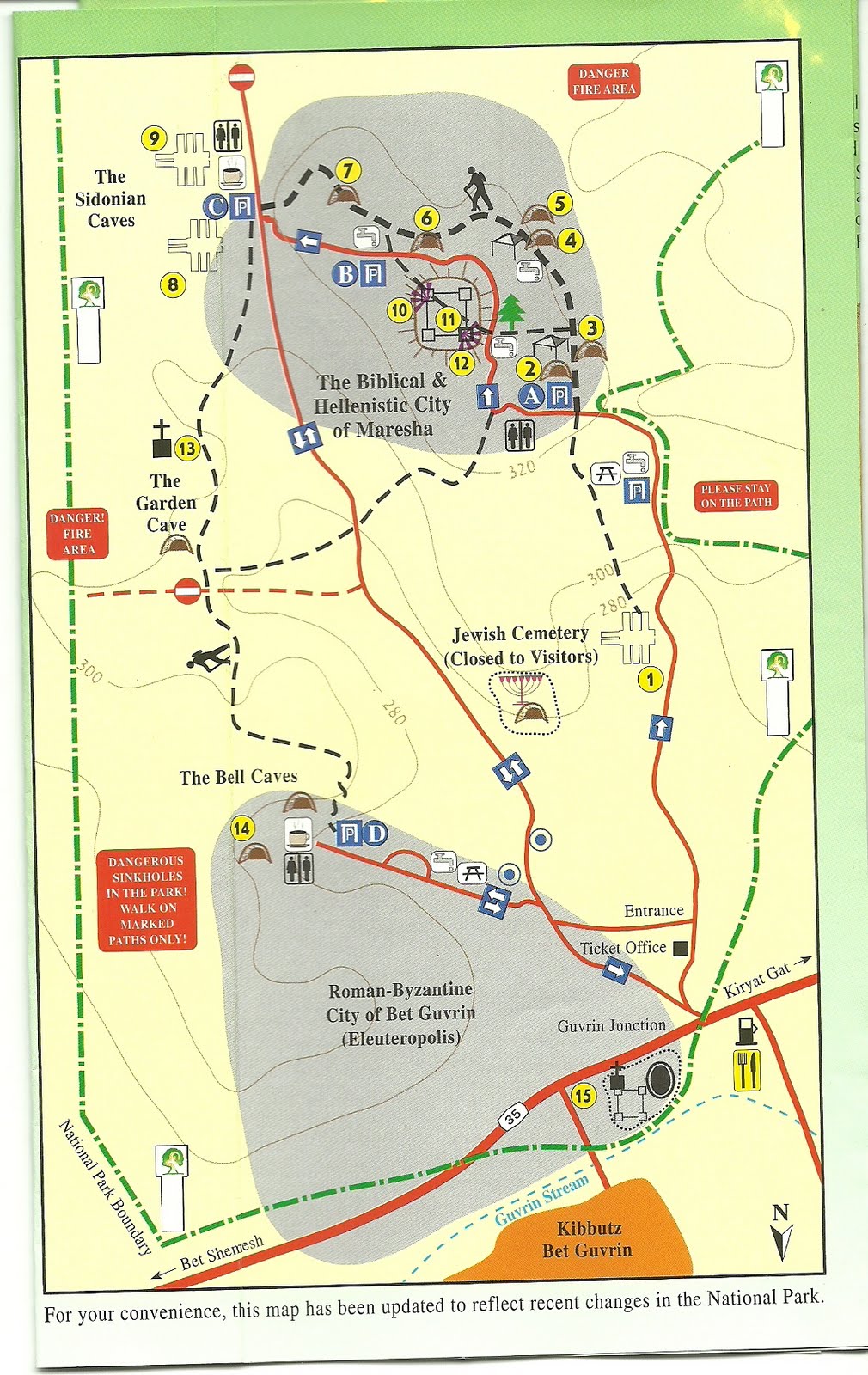
Marilyn and I visited Beit Gurvin-Meresha National Park (AKA Eleutheropolis and Tel Sandahannah), today in preparation our guests to participate in Dig For A Day. We met with Asaf Stern who works in the program part time, Arava Alon who is a regular staff person in the program 054 314-5700 and Asaf's father the head of the program Dr. Ian Stern an archeologist.
There are basically three major sections to visit in the park" 1.) the Sidonian Cave near the information center; 2. the Bell Caves near the entrance to the park and 3. Amphitheater with Crusader church net store (before the main entrance of the park in back of the gas station.)
[From the Park Brochure..]
The national park has an area of 1,235 acres. The site is in the basin of the Guvrin Stream at the point of transition from the lower to the higher shephela at an altitude of 820-1,150 feet above sea level. The site was an ancient crossroads from the coastal plain to the Judean Hills and north to south through the shephela.
The bedrock here is limestone (kirton) tens of feet thick. Above it is a hardened cap of harder limestone called nari 5-10 feet thick. The nari had to be removed via small holes to get to the softer kirton. The quarrying of the kirton resulted in the Bell Caves. The quarried rock was cut into building stones. The follow spaces left behind were used as industrial installations, water reservoirs, storerooms, to keep cattle or beasts of burden and as burial caves.
Archeological Research
History of Excavations:
1900: Fredrick Jones Bliss (1859-1937) and Robert Alexander Stewart Macalister (1870–1950) excavated at Maresha for British Palestine Exploration Fund.
1902: Thiersch and Peters (Sidonian Burials)
1969-75 Ben Arieh (survey)
1989-onward Amos Kloner (Israel Antiquity Authorities)
Chronicles of Maresha
Maresha is mentioned among cities of Judea noted in Joshua 15:44 and as one of the cities fortified by King Rehoboam against the incursion of the Babylonians into his Kingdom (Chronicles 2 11: 5-8) and Chronicles 2 14:8-10.
During the Persian Period following the destruction of the 1st Temple in 586 BCE, Maresha and all of southern Judea was settled by Edonmites who came from the northeast. At the end of that period in the 4th Century BCE, the place was inhabited by Sidonians (from the city of Sidon near Tyre) and even Greeks bringing the Hellenistic culture with them. Egyptians and Jews also settled in the area at the same time. Thus Maresha became a Hellenistic city. During this period the lower city was built and many caves were hewn.
The Hasmonean King John Hycanus I in 113 BCE conquered Maresha and converted the residents of the city and the region to Judaism. The city became desolate ruins. It was briefly sparsely populate but destroyed by the Parthian invasion in 40 BCE.
Chronicles of Beit Guvrin
Beit Guvrin replaced Maresha as the most important settlement in the area. It is mentioned by the Jewish historian Josephus Flavius in 68 CE as one of the cities conquered by the Roman General Vespasias. Following the destruction of the Second Temple in 70 CE, it continued to exist as a crowded Jewish settlement until the Bar-Kochva Revolt 132-35 CE.
In 200 CE the Emperor Septimus Severus changed Beit Gurvin's name to Eleutheropolis ("City of the free") and granted it municipal status.
During the Byzantine period, Beit Gurvin was an important Christian town with a number of Churches.
During the early Muslim period, most of the caves were dug.
It became an important Crusader town. The early Byzantine St. Anne's Church was rebuilt in 1136 CE.
Tuesday, March 15, 2011
Sample 9 Day HOLY LAND ITINERARY
Friday Day One - The Old City of Jerusalem on Sabbath Eve
8:30 AM Arrive at Jerusalem International YMCA 3 Arches Hotel, King David St. (across from King David Hotel).
9:00 Drive up to Mt. of Olives observation point.
Enjoy and learn to identify the significant sites of the Old City of Jerusalem looking west.
Walk down the Pilgrim’s Path walking in the footsteps of Jesus on his way to the Last Supper.
Visit the Franciscan Dominus Flavit Chapel on the way to the Garden of Gethsemane and Church of All Nations.
Drive to Zion Gate and visit the Room of the Last Supper and enter into the Old City at the Armenian Quarter. Visit the Jewish Quarter and the Cardo (the heart of the Roman/Byzantine city)
Walk down to the Western (Wailing) Wall.
12:30 Visit the Davidson Center Archaeological Park (admission fee 30 NIS) (Closes at 14:00)
15:00 Friday Procession- from Chapel of the Flagellation on Via Dolorosa via the Muslim Quarter into the Christian Quarter to explore the Holy Sepulchre we will plan to walk with the Franciscan monks on this route.
Check into the 3 Arches Hotel – Jerusalem International YMCA (across from King David Hotel) (02) 569-2692
Shabbat Dinner
Overnight Jerusalem
Saturday Day Two - The Dead Sea Adventure
8:00 AM Depart YMCA Hotel on way to Dead Sea Adventure
Visit the fascinating fortress at Masada (Entrance Fee 49 NIS includes cable car) Museum recommended (20 NIS) (08) 658-4207/8
14:00 PM Take a walk in the Ein Gedi Nature Reserve (Entrance fee 27 NIS) 08-658-4285
15:00 Visit Qumran where the Dead Sea Scrolls were found hidden in caves 02-994-2235 21 NIS
16;00 Dead Sea “swimming” Kalia Beach (02)994-2391
Return to the hotel…Dinner TBA number of options
8:30 PM attend the Tower of David Sound and Light Show (admission 75 NIS) (02) 626-5333
Overnight in 3 Arches Hotel Jerusalem International YMCA Jerusalem
Sunday Day Three - Exploring more of Jerusalem and its history
7:00 AM Depart Hotel for Tour of the Temple Mount (Should be in line by 7:30 AM)
Optional – Sunday morning church service if desired
8:30 AM Drive to and visit Yad Vashem the Israel Holocaust Museum. (02) 644-3400
11:00 AM: Drive to the Israel Museum – visit the Second Temple Model, the Shrine of the Book that stores the Dead Sea Scrolls and the newly renovated archeological exhibit. (Admission 49 NIS) (02) 670-8811 (open 10-17; Tuesday 16-21)
3:00 PM Driving tour of view points around Jerusalem with a stop at the grave of Oskar Schindler (note that the gate to the cemetery is often locked). To get to it, walk about 300 yards downhill from the Zion Gate until you come to a small parking lot, across the road from which are two unmarked gates. Walk through the right gate and into the cemetery, and then down two levels to find it near the center of the third (the lowest) level. The stones on top may help you find it.
Dinner and early evening free time – program will be scheduled depending on interest.
9:10 PM Western Wall Tunnel Tour (Scheduled and booked)
Overnight 3 Arches Hotel Jerusalem
Monday Day Four – Going up to the Sea of Galilee
8:00 AM Check out of the Hotel (May leave extra bags in storage)
Drive to Jericho border crossing and meet your guide for tour. 10:00 (pending suitable guide)
Drive to Sea of Galilee (aka Lake Kinneret)
1:00 PM Check in at Rimonim Galei Kinneret Hotel (04) 672-8888 [Mark and Marilyn will stay at the Peniel Hotel nearby] Salah (057) 223-1293
Visit the major sites on the northwest side of the Sea of Galilee, Tabghe (Fish and Loaves) (8:30-17), Capernaum (home of Jesus) (8:30-16:00) 04-679-3865, Mount of Beatitudes (8:30-12,-14:30-17:00) Peter’s Primacy (8-12;14-17).
Evening walk on the Tiberias Promenade
Overnight Tiberias
Tuesday Day Five - Exploring the Golan Heights
8:00 AM Depart Hotel
View ancient “Jesus Boat” in the Yigal Allon Museum at Kibbutz Ginossar.
(Admission fee 25 NIS)
Boat ride on the Sea of Galilee (054) 686-4247 (Daniel Carmel)
Drive up to the Golan Heights stop at Peace Viewpoint
Visit Gamla Nature Reserve The Masada of the North and Vulture Reserve
04-682-2285 8 A.M.–16 P.M 27 NIS
Look over the Valley of Tears site of major tank battle of Yom Kippur War
Overnight Tiberias
Wednesday Day Six – Exploring Northern Israel
8:30 AM Check out and depart hotel
Visit the Holy City of Safed- Roman Citadel, Synagogues and Artist Quarter
Drive to and visit Nazareth and visit the Church of the Annunciation and Old City
Overnight Nazareth Golden Crown Hotel 04-650-8000, 1-800-600-601 | Fax 04-601-6007
Thursday Day Seven – Antiquities from Megiddo and Caesarea to Ashkelon
8:00 AM Check out and depart hotel
Visit Megiddo Archaeological Site (8 A.M– 4 P.M) (04) 659-0316 27 NIS
Visit Caesarea Maritima Archaeological Site (8 A.M– 16 P.M) (04) 626-7080 38 NIS
Visit Ashkelon Archaeological Site (8 A.M.–22 P.M) Entrance fee 27 NIS
Check in to Holiday Inn Ashkelon 08-6748888
Overnight Ashkelon (Move clocks forward 1 hour for Daylight Savings Time at 2 AM)
Friday Day Eight – Drive to Jerusalem stopping at the Beit Guvrin Archeological Site
9:30 AM Dig for a Day archeological experience at Beit Gurvrin (Hadas (02) 586-2011
Check into the 3 Arches Hotel at Jerusalem YMCA
13:30-15:30 PM Bethlehem Tour Guide with Elias Ghareeb (052) 237-3317 (059) 967-4991
Jerusalem will be closing down for the Jewish Sabbath starting at sun down. We will plan the afternoon and evening given these constraints and your interests. A walk around west Jerusalem neighborhoods and visit to the Mahane Yehuda open air shuk should be fun.
Overnight Jerusalem
Saturday Day 9 - Final Day of Adventures in and Around Jerusalem
10 AM Jerusalem History Museum – Tower of David
Depart for Airport 7:30 PM
We will plan this day, remembering it is the Sabbath in Jerusalem. We will fill in any items that you would like to do at the last minute. The Jerusalem Historical Museum at David’s Tower just inside the Old City is open 10AM – 2 PM. The Old City will be open…perhaps we might consider the Wall Walk around the Old City.
The othe option could be Herodion National Park (Open on Saturday) 050-623-5821 (at site); 057-776-2251; 057-776-1143 27 NIS 8:00-16:00 (winter)
Subscribe to:
Posts (Atom)